Why I Choose Positive Reinforcement
It's About More Than “good boy”s and treats. It's About Relationships.
Smart Paws Academy | Gettysburg, Hanover, Littlestown, PA
As dog owners, we all want the same things. We want a dog who can walk politely on a leash, greet guests without jumping, come when called, settle quietly in the house, and enjoy being part of the family.
There are many paths that promise those results. Some rely primarily on correcting unwanted behavior. Others focus on rewarding the behavior we'd like to see more often. Most include some combination of rewards and corrections.
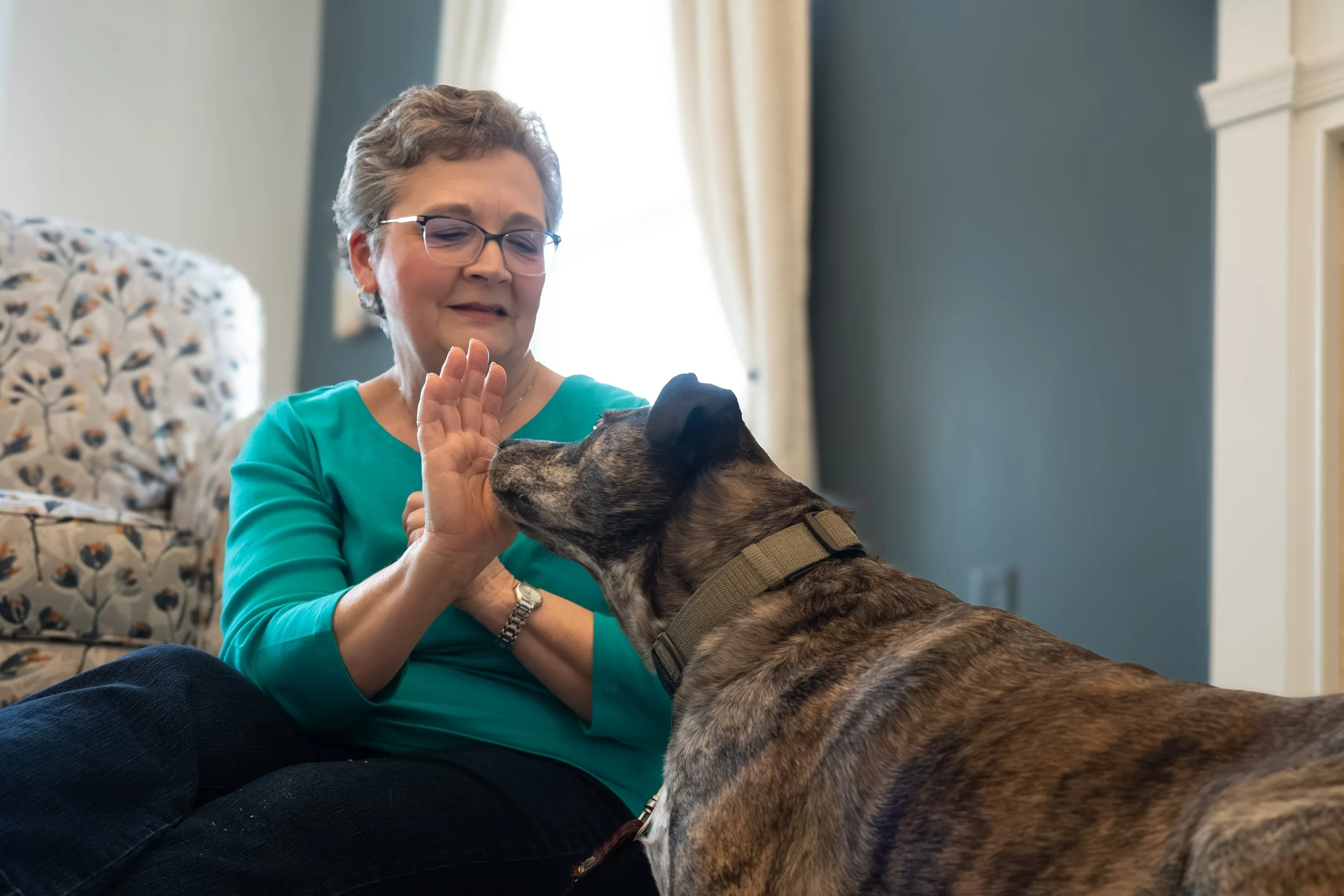
At Smart Paws Academy, I choose positive reinforcement. Not because it's the newest trend or the easiest or fastest way to get results, but because it reflects what we know about how dogs learn and leads to the kind of relationship I want families to build with their dogs. For me, training has never been just about changing behavior. It's about building trust, confidence, and understanding between dog and owner. It’s about living your best life together.
Why dogs do what they do
One of the most important lessons I've learned is this: Just like people, dogs always have a reason for what they do. That doesn't mean every behavior is acceptable or that it makes sense to us, but it does mean that every behavior serves a purpose from the dog's point of view. A dog who barks at visitors may be afraid. A dog who pulls on the leash may be excited to explore. A puppy who jumps may simply be asking for attention the only way he knows how. A dog who growls is saying “I’m not comfortable”. You could say she is “using her words” before resorting to more serious behavior. When we understand why a behavior happens, we're in a much better position to teach something better.
So before asking, "How do I stop this?" I encourage my clients to ask, "What is my dog trying to tell me?" That question changes everything.
From noise to nurture.
Many of the dogs I work with hear the word “no” so often that it becomes mere background noise. No to jumping. No to chasing. No to stealing my socks. I ask my clients to remove that word from their training vocabulary, because no matter how many times we scold them, dogs will be dogs—every chance they get. Our job is not to catch our dogs making mistakes and then correct them. Our job is to teach them how to succeed in our human world while still being the wonderful dogs they are.
Think about teaching a child to ride a bicycle. We don't wait for them to fall so we can point out what they did wrong. We explain how it works—how to stop, go, and keep pedaling. We make it safe by holding the seat and keeping it steady. We encourage. We celebrate every small success. And then gradually, when it feels safe, we let go and watch apprehension turn to confidence, and confidence to joy.
Dog training works much the same way. Rather than waiting for unwanted behavior to happen, we try to create opportunities for dogs to practice making good choices. We reward every small success, even before it’s perfect. This way, our dog’s behavior is shaped by practicing the “yes” rather than avoiding the “no”. Every repetition builds understanding and skill, every success builds confidence. Knowing how to succeed, and finding it rewarding, is what builds trust and strengthens the relationship between dog and owner.
We use plenty of treats, but . . .
One of the biggest misconceptions about positive reinforcement training is that it's simply about handing out treats for good behavior.
Treats are only one of many tools that we use in training. We also use games and puzzles and calming activities, and yes—we always pay well. Sometimes the reward is food (don’t we all work for our food?). But we also reward with praise, or a game of tug, or permission to greet a friend, sniff a bush, or hop into the car. Effective training is all about helping your dog discover that good choices lead to good outcomes. Along the way, those good choices become habits, and life itself becomes rewarding. It’s all part of building a lifelong bond between dog and owner.
Getting from chaos to calm.
Why do our dogs misbehave? Why do they ignore us when we call, or erupt into chaos when the doorbell rings? Most of the time, it’s not intentional. They’re not being stubborn. It’s far more likely that they’re simply overwhelmed. Or excited. Or worried. Or frustrated. Their nervous system reacts faster than their brain can think.
And that can change. For most of our canine friends, calm is not a personality trait, or something that magically appears with age. It is a skill that any dog can learn through patient, thoughtful practice. We build it by creating many small, unhurried moments where your dog can notice the world, think about what's happening, and discover that calm choices lead to good things. While they can sometimes seem uneventful, these are the moments that quietly transform your dog's emotional response to the world.
Considering the whole dog.
One framework that has deeply influenced my work is the L.E.G.S.® model developed by Kim Brophy, a renowned ethologist and canine behavior consultant.
L.E.G.S. reminds us that every dog is shaped by four interacting influences:
Learning —Dogs are always learning. What is your dog learning all day, every day, as he interacts with the world around him?
Environment — How is your dog being shaped by her environment? How does it help or hinder her ability to succeed in the human world?
Genetics — What natural instincts and breed tendencies are part of this dog's story?
Self —This considers such things as health, gender, age, temperament, and personality. What qualities, limitations, experiences, challenges, and superpowers make your dog who they are?
No single factor explains every behavior, but together they remind us to look beyond the surface to appreciate and nurture the dog in front of us.
Instead of seeing a "stubborn dog," we begin seeing a learner with a unique history, unique instincts, and unique needs. That perspective leads to more compassionate—and often more effective—training.
Leadership, Not Dominance.
People sometimes ask me if positive reinforcement means dogs don't need boundaries.
Absolutely not. Dogs thrive when life is predictable. They need routines, guidance, and clear expectations. They need someone they can trust to lead them through situations they don’t understand. I believe the best leaders lead with consistency, patience, and trust rather than force or intimidation. Because the goal isn't to make a dog afraid of making the wrong choice. The goal is to help the dog become confident enough to choose the right one. Those are two very different paths.
The Ultimate Goal--Relationship
Down the road, long after the treats have tapered off and the training sessions have ended, long after "sit," "stay," and "come" have become part of everyday life, something even more important remains.
A dog who looks to you when life feels uncertain and trusts your guidance.
A family that understands their dog's needs instead of feeling frustrated by them.
A relationship built on communication instead of conflict.
That's the kind of training I want to help create--not because it's easier or more fashionable, but because I believe our dogs deserve more than obedience. They make our lives richer. They love and accept us just as we are. They forgive our mistakes. They deserve the same from us. And when dogs feel understood, loved, and protected, remarkable things begin to happen.
At Smart Paws Academy, that's the journey I hope to take with every family I meet.